
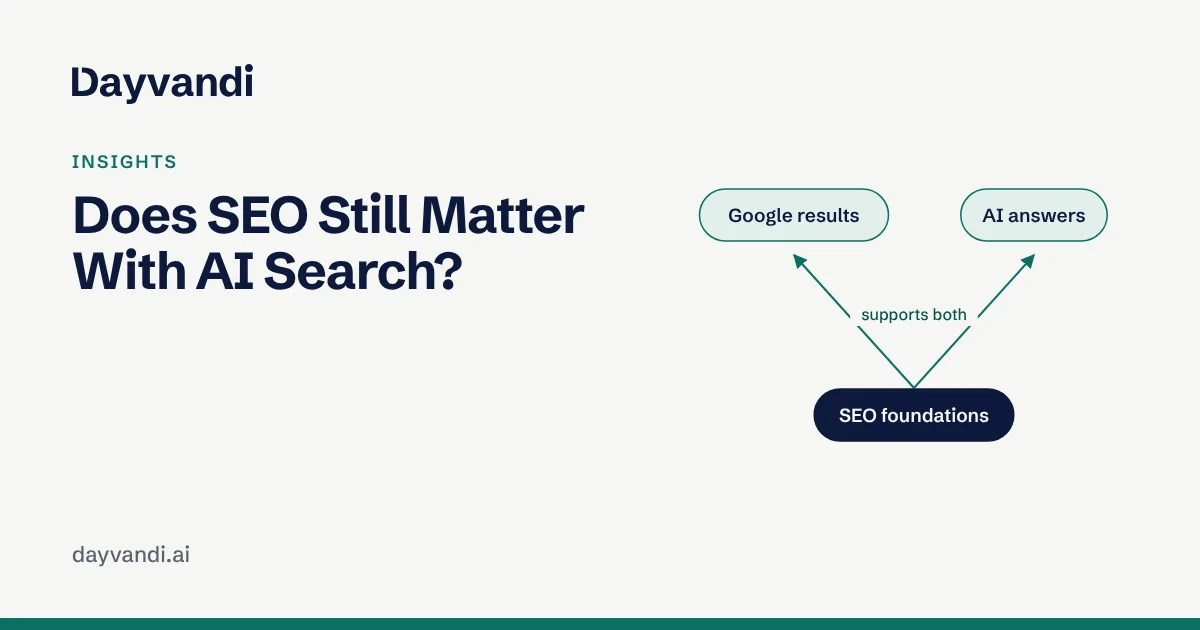
In short: yes. Google’s AI Overviews and AI Mode are built on Google Search, and other AI platforms draw heavily on web search results and crawled pages. The pages that rank and the brands that are well referenced are the ones AI tools tend to use. What has changed is how value shows up: fewer clicks on simple questions, more weight on being cited, and more importance on the pages where buyers make decisions.
Key takeaways
- AI search tools draw on web search indexes and crawled pages, so SEO remains the foundation of AI visibility.
- Simple informational questions now send fewer clicks, and being cited in AI answers is a new form of visibility.
- Decision-stage pages, such as services, pricing, comparisons and proof of expertise, carry more weight than before.
- The priorities are crawlable pages, an unambiguous brand, first-hand content, and AI visibility tracked alongside rankings.
In 2014 I wrote a short piece arguing that SEO should stay part of every marketing strategy, even after Google’s Hummingbird update changed how search worked. The argument then was that search engines change but the need to be found does not.
AI search is a much larger change than Hummingbird. The argument still holds.
Why does AI search still depend on SEO?
AI tools need sources. Google’s AI features draw on Google’s index. ChatGPT search, Perplexity and Copilot use their own crawlers and search partnerships to retrieve pages before writing an answer. In each case, a page that cannot be crawled, is poorly structured or lacks authority is unlikely to be used.
The foundations of good SEO are the foundations of AI visibility:
- Pages that search engines and AI crawlers can access and read
- Clear information about who you are and what you offer
- Content that answers real questions with specific detail
- A reputation confirmed by credible independent sources
What has changed with AI search?
Fewer clicks on simple questions
When an AI answer settles a quick factual question, fewer people click through. Traffic to purely informational content that anyone could write is under the most pressure.
Being cited is a new kind of visibility
A brand mentioned or recommended in an AI answer gains visibility even without a click. That is harder to measure than a ranking, but it influences what buyers consider.
Decision-stage pages matter more
People still visit websites when they are ready to compare, check prices, read case examples and get in touch. Service pages, pricing information, comparisons and proof of expertise carry more of the load.
Where should you focus now?
- Fix the foundations. Make sure your important pages are crawlable, indexable and fast, and that AI crawlers are not blocked by accident.
- Make your brand unambiguous. Use consistent names, structured data and accurate profiles so search engines and AI tools can identify you with confidence.
- Invest in content only you can write. First-hand experience, original data and specific examples are what make content worth citing.
- Strengthen decision-stage pages. Be clear about what you offer, who it is for, what it costs and why someone should choose you.
- Measure AI visibility alongside rankings. Track a consistent set of buyer questions across the major AI platforms, and watch AI referral traffic in GA4.
The bottom line
AI search has not replaced SEO. It has raised the bar. Generic content and shortcuts are worth less than ever, and genuine expertise, clear information and a real reputation are worth more. That was always the direction search was heading. AI has simply made it impossible to ignore.