
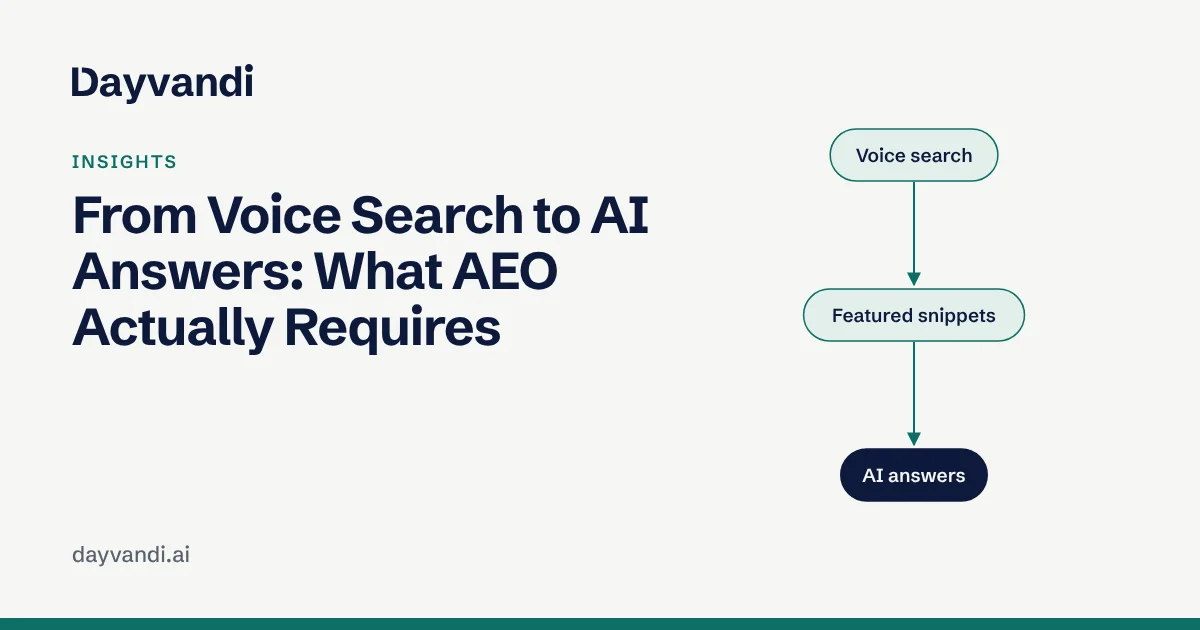
In short: answer engine optimization (AEO) is about being the source an AI tool or search feature uses to answer a question. It rewards the same things voice search did: direct answers, natural question phrasing and consistent business information. It adds new demands: corroboration from other sources, crawl access for AI bots, and a different way of measuring success.
Key takeaways
- Answer engine optimization (AEO) means being the source an AI tool or search feature uses to answer a question.
- Direct answers, natural question phrasing and consistent business information carried over from voice search.
- AI answers combine several sources, so your claims need corroboration and AI crawlers need access.
- AEO is measured by tracking a fixed set of buyer questions across AI platforms, not by a ranking position.
In late 2019 I wrote a guide to optimizing for voice search. At the time, a widely repeated prediction said half of all searches would be voice searches by 2020. That never materialized the way it was forecast. Smart speakers found a place for timers, weather and music, not for researching which accountant to hire.
But the advice in that guide holds up better than the prediction did, because voice search was an early version of something much bigger: people asking a machine a question and expecting one answer back.
What carried over from voice search?
Answer the question directly
Voice assistants read out a single answer, often taken from a featured snippet. The pages that won were the ones that answered a question clearly in the first sentence or two, then expanded. That is still the single most useful habit for AEO. Lead with the answer, then give the detail.
Write the way people ask
People speak and type to AI tools in full questions: “What does an SEO audit include?” rather than “SEO audit checklist.” Pages that use natural question phrasing in their headings, and answer each one directly beneath it, map neatly onto those prompts.
Keep business information consistent
My 2019 guide put consistent name, address and phone details first, because assistants pulled local answers from listings. AI tools still rely heavily on map, directory and review data for local recommendations. Inconsistent details make you harder to trust and easier to leave out.
Speed and accessibility
A page that loads slowly or hides its content behind scripts is less likely to be used, whether by a voice assistant in 2019 or an AI crawler today.
What changed with AI answers?
Answers are now synthesized
A voice assistant usually read one source. AI tools combine several. That means being the best page is not always enough. Your claims need to be consistent with what other credible sources say about you and your topic. Reviews, industry publications and directories all feed into that picture.
AI crawlers need access
Several AI platforms run their own crawlers. If your robots.txt file or firewall blocks them, those platforms have little of your content to work with. Check what you allow, deliberately.
Specifics beat generalities
AI answers tend to favor content with concrete detail: what something costs, how long it takes, who it is for, how it compares with alternatives. Pages full of general marketing language give a model nothing quotable.
Measurement is different
There is no single ranking position to track. Measuring AEO means running a consistent set of real buyer questions across the major AI tools on a schedule, then recording whether you are mentioned, cited or recommended, and how accurately. AI referral traffic in GA4 adds another signal.
What does an AEO checklist include?
- Open every key page with a one or two sentence answer to its main question
- Use question-style headings that match how buyers ask
- Include concrete facts: pricing context, timelines, specifications, comparisons
- Add an FAQ where people genuinely have follow-up questions
- Keep business details identical across your site, Google Business Profile and directories
- Mark up your organization, services and FAQs with accurate structured data
- Confirm AI crawlers can reach and read your pages
- Track a fixed set of buyer questions across AI platforms every month
Voice search turned out to be a preview, not the main event. The businesses that learned to give clear, direct, consistent answers then are well placed now.